EN
 TR
 DE

The Grand Bazaar: How to Navigate 4,000 Shops Without Losing Your Mind
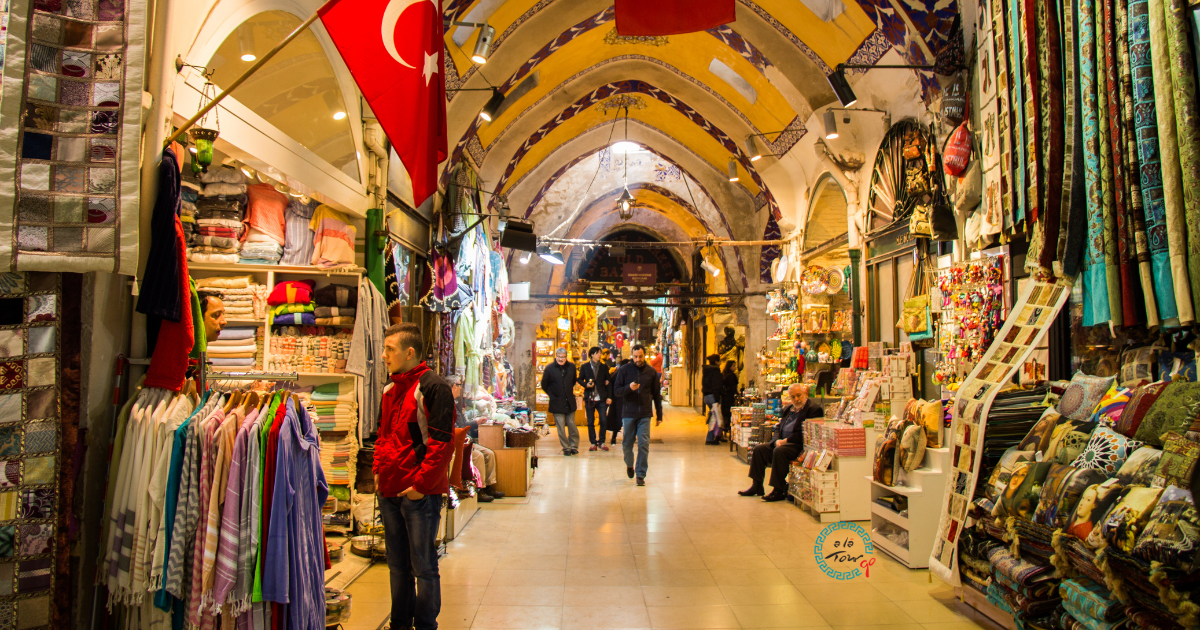
The Grand Bazaar is not a market. It is a walled town with a roof on it — about 4,000 shops along 61 covered streets, spread over roughly 30,000 square metres, with somewhere between 18 and 22 gates depending on who is counting. It has been trading since the 1460s. Almost every visitor walks in through the nearest gate, turns twice, and loses all sense of direction within four minutes.
That is normal, and it is fixable. The bazaar has a logic: trades are grouped by street, and the streets run on a rough grid around one central spine. Learn that spine and the rest falls into place.
The basics, before you go
| Opening hours | Monday–Saturday, about 08:30–19:00 |
|---|---|
| Closed | Sundays, and the first days of the religious holidays (Ramazan Bayramı and Kurban Bayramı) |
| Entry | Free |
| Best time | Right at opening, or after 16:00 |
| Budget | At least 90 minutes to walk it; half a day if you intend to buy something considered |
Individual shops keep their own hours, so a few shutters stay down early in the morning and the antique dealers in the inner halls often close before the rest. Sunday closure catches people out constantly — if Sunday is your only free day in Istanbul, go to the Spice Bazaar or the Arasta instead and save the Kapalıçarşı for a weekday.
Choose your gate deliberately
Which gate you use decides what the bazaar feels like for the first ten minutes.
Nuruosmaniye Gate — the one to use
The grandest entrance, marked with the Ottoman imperial coat of arms, reached from the Nuruosmaniye Mosque courtyard. It opens directly onto Kalpakçılar Caddesi, the bazaar's main artery and its gold street. Walk in here and you are instantly on the spine, with the whole grid branching off to your right.
Beyazıt Gate — best for public transport
Closest to the Beyazıt–Kapalıçarşı tram stop and to Beyazıt Square, the university and the Sahaflar Çarşısı second-hand book market. It drops you at the far end of Kalpakçılar, so you can walk the spine from one end to the other and come out at Nuruosmaniye.
Mahmutpaşa Gate — for the walk downhill
Use this one on the way out. Mahmutpaşa Yokuşu is the busy, un-roofed slope of textile wholesalers that runs down to the Spice Bazaar and Eminönü. It is chaos, and it is the best street photography in the district.
Where everything is
Trades cluster. Once you know the clusters you stop wandering.
| What you want | Where to go |
|---|---|
| Gold and fine jewellery | Kalpakçılar Caddesi, the main spine |
| Antiques, old silver, Ottoman curiosities | Cevahir Bedesten (also called İç Bedesten), the vaulted stone hall at the centre |
| Carpets and kilims | Around Takkeciler and the lanes near the Cevahir Bedesten |
| Textiles, scarves, pashminas | Sandal Bedesteni and the Yağlıkçılar lanes |
| Ceramics, tiles, lamps, copperware | The lanes north of the spine, and heavily around all tourist gates |
| Leather | Perdahçılar and the eastern lanes |
The Cevahir Bedesten is worth finding even if you buy nothing. It is the oldest part of the complex, built under Mehmed II between roughly 1455 and 1461, and its thick stone vaults served as the city's strongrooms for centuries. It is quieter, the lighting is dimmer, the pieces are genuinely old, and the prices reflect that. Treat it as a small museum you are allowed to shop in.
The orientation trick
Forget maps — phone signal is patchy under the vaults and the street names are on plaques you will not look up at. Do this instead:
- Find Kalpakçılar once. It is the widest street, it is wall-to-wall gold shops, and it runs the full length of the bazaar. Everything else is a rib off this spine.
- Count your turns off it. Go in, turn off, and come back the same way. Two turns deep is plenty; three and you are relying on luck.
- Use the gates as landmarks, not the shops. Shops look identical after a while. Gates are numbered and signposted.
- If you are lost, walk uphill. The bazaar slopes. Uphill brings you toward Beyazıt and Nuruosmaniye; downhill pushes you toward Mahmutpaşa and out of the covered section entirely.
If you would rather not do the orientation yourself the first time, our Istanbul Grand Tour includes the Grand Bazaar with a licensed guide who knows which lanes are worth your time and which are a souvenir conveyor belt — and then leaves you free time inside to shop on your own.
Prices and bargaining, honestly
Not everything is negotiable, and assuming it is will embarrass you.
- Gold is not negotiable. It is sold by weight at the day's gold rate plus a workmanship charge. You can discuss the workmanship charge. You cannot discuss the gram price.
- Carpets, leather, ceramics and souvenirs are negotiable, and the first price quoted usually assumes you will negotiate.
- Food, water and café bills are fixed. Nobody haggles over a tea.
Bargaining here is a conversation, not a contest. Ask the price, show real interest, make one counter-offer you would genuinely be happy to pay, and settle somewhere in between. Walking away is a legitimate move and nobody is offended by it — but walking away over the last 50 lira on something you loved is a bad trade. We go through the actual script, line by line, in our guide to bargaining in Turkish bazaars.
Two practical notes. Many shops quote in euros or dollars for tourists; ask for the lira price as well and compare, because the shop's exchange rate is rarely the bank's. And card payments sometimes attract a quiet surcharge, so ask before you hand the card over.
Buying something that matters
A fridge magnet needs no strategy. A carpet does. If a rug is anywhere on your list, read how to buy a Turkish carpet without getting ripped off before you sit down for the first glass of tea — once you are seated and the rugs start unrolling, it is much harder to think clearly.
For ceramics, learn one distinction: hand-painted Iznik-style pieces have slight irregularities in the brushwork and cost accordingly; transfer-printed pieces are perfectly uniform and cheap. Both are fine to buy. Just know which one you are paying for.
For anything you intend to carry home, check weight and fragility before you commit. Most established shops will arrange shipping, and for a heavy copper tray or a large rug that is usually cheaper than the airline's excess baggage.
What to skip
The lanes immediately inside the busiest tourist gates are the most expensive square metres in the bazaar and sell the least interesting things. Walk three minutes deeper before you buy anything. Also: anyone who approaches you in the street outside the bazaar offering to take you to "his cousin's shop" is working on commission, and you will pay it.
Practical details
- Getting there: T1 tram to Beyazıt–Kapalıçarşı or Çemberlitaş; both are a two-minute walk from a gate.
- Toilets: Inside, signposted, small fee.
- Cash: Carry some lira. Most shops take cards, but small purchases and tea are easier in cash.
- Pickpockets: Rare but real in the crush. Front pockets, bag in front, that is all it takes.
- Tea: If you are offered tea, you may accept it and still not buy. That is understood on both sides.
The Grand Bazaar rewards a second visit more than almost anywhere else in Istanbul. The first time you are just learning the shape of it. The second time you know where you are going, and it turns from an ordeal into one of the best hours in the city.
Türkiye'yi Keşfetmeye Hazır mısınız?
Uzman rehberlerimizle Türkiye'nin en etkileyici destinasyonlarında unutulmaz bir yolculuğa çıkın.
Turları Keşfet