EN
 TR
 DE

Troy: What's Actually There, and Why It Still Matters
Let us be honest at the start, because almost no article about Troy is. If you arrive expecting walls, towers and a recognisable ancient city, you will be disappointed. What is there is a low mound of trenches, foundations and sections of wall from nine different cities built on top of each other over three thousand years.
And that, once you understand it, is far more interesting than what you were expecting.
Nine cities, one hill
People have been settling this hill since about 3000 BC. Each time the city was destroyed, by war, fire or earthquake, the next one was built on the rubble. Archaeologists number the layers Troy I through Troy IX, running from the Early Bronze Age to the Roman period.
So when you look at the excavation, you are not looking at one city. You are looking at a cross-section through three millennia, with Bronze Age stone sitting under Roman brick within a few metres.
Which layer is Homer's Troy? The usual candidates are Troy VI and Troy VIIa, and the destruction of Troy VIIa, around 1180 BC, fits the traditional date of the war best. Whether a war happened at all, and whether Homer was describing it or inventing it four hundred years later, is still argued about. That argument is part of the appeal.
What Schliemann did
Heinrich Schliemann, a wealthy German businessman convinced the Iliad was literally true, began digging here in the 1870s. He found the site. He also drove an enormous trench straight down through the middle of the mound, destroying much of the layer that was probably Homer's Troy in order to reach the older ones underneath, because he assumed the famous city had to be at the bottom.
He also found a hoard of gold he announced as Priam's Treasure, which was from a layer a thousand years too early, and removed it from the country. Most of it ended up in Berlin, was taken to the Soviet Union in 1945, and is now in Moscow.
The trench is still visible. It is one of the most consequential acts of archaeological vandalism in the discipline's history, and standing in it is genuinely strange.
The museum is the main event
The Troy Museum, opened in 2018 in the village of Tevfikiye just outside the site, is a rust-coloured steel cube that descends underground, and it is one of the best museums in Turkey.
It does the job the ruins cannot: it explains the layers, shows the finds, and traces how the Troy story travelled through Greek, Roman, medieval and modern culture. Go here first, then walk the site. In the other order the ruins mean very little.
The horses
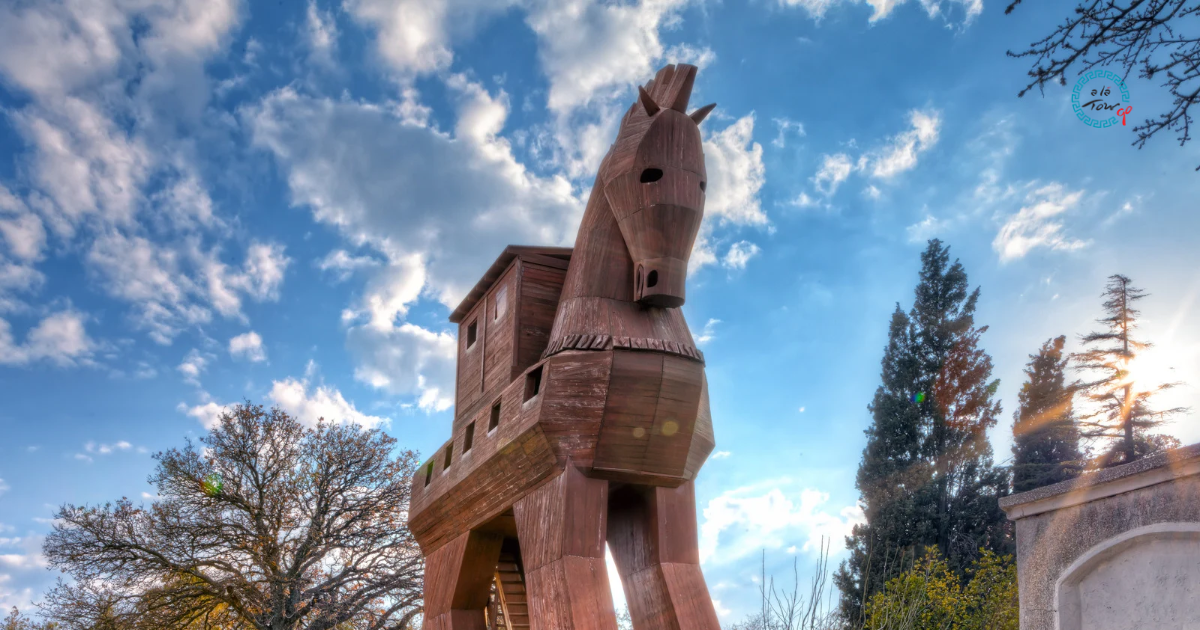
There are two wooden horses and neither is ancient. A climbable replica stands at the site entrance, built in the 1970s. The horse used in the 2004 film is on the seafront in Çanakkale town, donated by the production.
Both are fun, both are photographed constantly, and neither has anything to do with archaeology. That is fine. Just know what you are posing with.
Visiting
| Where | Near Tevfikiye, about 30 km southwest of Çanakkale |
|---|---|
| Getting there | Dolmuş from Çanakkale otogar, or a taxi. From the Gallipoli side, cross the Dardanelles by ferry from Eceabat first. |
| Time needed | About an hour at the site, 90 minutes at the museum |
| Terrain | Uneven paths and some steps, exposed to sun and wind. Hat and water in summer. |
| Guide | Worth more here than at almost any other site in Turkey |
A guide is not a luxury at Troy. Without one, nine layers of foundations look like a quarry. With one, you can see where the Bronze Age wall meets the Roman theatre and understand why that matters.
Fitting it into a trip
Troy is almost always combined with Gallipoli, an hour away across the strait, and the two make a natural pair: the oldest war story in European literature and one of the most consequential battles of the twentieth century, within sight of the same water. Our Marmara Region tour links them with the rest of the region.
If you want a sense of how much Turkey's ancient sites vary in what they actually show you, the contrast with a site like Zeugma is instructive: there, the finds are overwhelming and the site is underwater. Here, the site is everything and the finds left a century ago.
Go for the idea, not the stones. Three thousand years of people deciding this particular hill was worth rebuilding on is a better story than any wall could tell you.
Bereit, die Türkei zu erleben?
Begleiten Sie unsere erfahrenen Reiseleiter auf eine unvergessliche Reise zu den schönsten Zielen der Türkei.
Touren entdecken