EN
 TR
 DE

Zeugma Mosaic Museum: The Gypsy Girl and a Rescued Roman City
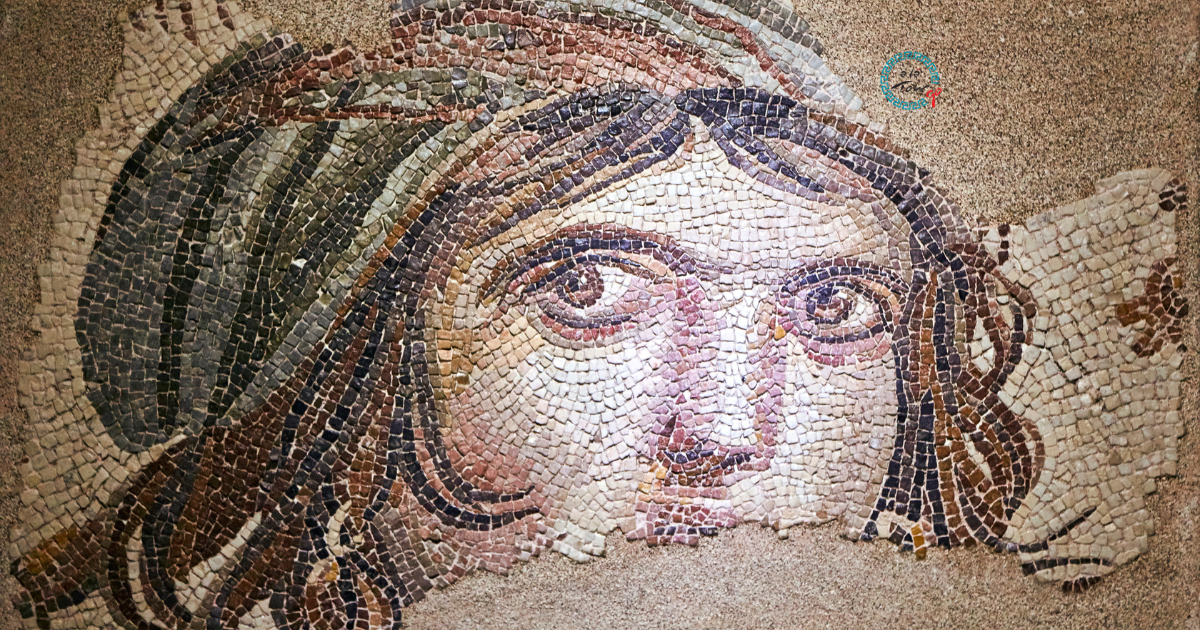
There is a face in a dark room in Gaziantep that will follow you. She is made of stone chips, she is about two thousand years old, nobody knows who she is, and the eyes track you across the floor. Turkey calls her the Gypsy Girl, and she has become the emblem of a city that most people have never heard of.
What Zeugma was
Around 300 BC, Seleucus I Nicator founded a city at the point where the Euphrates could be crossed. The Greek name says exactly what it was for: zeugma means a yoking, a joining, a bridge. Whoever held this crossing controlled the traffic between the Mediterranean world and Persia.
Rome took it in the first century BC and stationed a legion there. Trade money arrived, and with it a merchant class who built villas on the terraces above the river and floored them with mosaics in the way a wealthy family elsewhere might commission portraits. That is why so much of the art here is domestic rather than civic: these are dining-room floors.
In AD 253 the Sassanid king Shapur I sacked and burned the city. Catastrophe for the people who lived there, and the reason the mosaics survived: collapsed roofs and fire debris sealed the floors under a protective layer for the next seventeen centuries.
The rescue
In the late 1990s the Birecik Dam on the Euphrates began filling, and a substantial part of the ancient site was going underwater. What followed was one of the most urgent archaeological rescue operations in Turkish history: teams lifting mosaic floors by the square metre against a rising reservoir, with an actual deadline measured in weeks.
Part of Zeugma is now under the lake. What came out is in Gaziantep, and it is extraordinary.
The museum
The Zeugma Mosaic Museum opened in Gaziantep in 2011 and is generally described as the largest mosaic museum in the world. The official collection figures give a sense of the scale:
| Mosaics | 2,448 m² of Roman and Late Antique floors |
|---|---|
| Frescoes | 140 m² |
| Also displayed | Four Roman fountains, twenty columns, limestone statues, tomb stelae and sarcophagi |
| Centrepiece sculpture | A bronze statue of Mars, visible from every floor of the building |
The layout follows the ancient city's own terraces. Mosaics from the lowest levels, nearest the river, are near the entrance, and you climb as you would have climbed Zeugma itself. Full-scale reconstructions of a street, a fountain and villa walls are built around the floors, so you see the mosaics roughly where they sat rather than hung on a wall like paintings.
Give it two to three hours. It is far larger than it looks from outside and the lighting is deliberately low, which slows everyone down.
The Gypsy Girl, and the twelve pieces
She sits alone, on the second floor, in a darkened labyrinth of a room designed so that you come upon her rather than walk up to her. It works.
What you are looking at is a fragment. Her identity is disputed: a maenad, a personification of the earth, possibly Gaia, possibly nobody in particular. The name Gypsy Girl is modern and has no ancient authority at all. What is not disputed is the quality of the work in the eyes, which is what people mean when they say the gaze follows them.
The mosaic is also an object lesson in what the antiquities trade costs. In the 1960s twelve pieces were cut from the border of the floor she belongs to, taken out of the country, and sold in 1965 to Bowling Green State University in Ohio. Turkey began formally pursuing their return in 2012. The fragments came home in 2018, under an agreement between the Ministry of Culture and Tourism and the university, with Gaziantep Metropolitan Municipality involved in the repatriation. They are border masks, not the face itself, and the room now shows them alongside her.
Practical details
- Where: Şehitkamil, Gaziantep, on Hacı Sani Konukoğlu Bulvarı, a short taxi ride from the old city.
- Tickets: Entry is charged; check the current fee before you go, and see whether the Museum Pass Türkiye works out cheaper for your itinerary.
- Photography: Generally permitted without flash, but the low light defeats most phones.
- The site itself: A separate museum stands on the ruins at Belkıs, by the Euphrates, about an hour away. It is a different experience and worth it if you have the day.
Almost nobody flies to Gaziantep only for this museum, and nobody should. The city has the best food in Turkey and a seriously underrated old quarter, which we cover in our Gaziantep city guide. Zeugma also sits on the natural route through the southeast with Göbeklitepe, Şanlıurfa, Mardin and Mount Nemrut, which is how our Southeastern Anatolia tour is built.
One last thought, because the museum raises it whether you want it to or not. Zeugma survived being burned by an empire and did not survive a dam. The mosaics in that building are there because somebody decided they were worth racing the water for. That decision is visible in every room, and it is part of what you are looking at.
Ready to Experience Türkiye?
Let our expert guides take you on an unforgettable journey across Türkiye's most stunning destinations.
Explore Our Tours