EN
 TR
 DE

The Basilica Cistern: Istanbul's Underground Water Palace
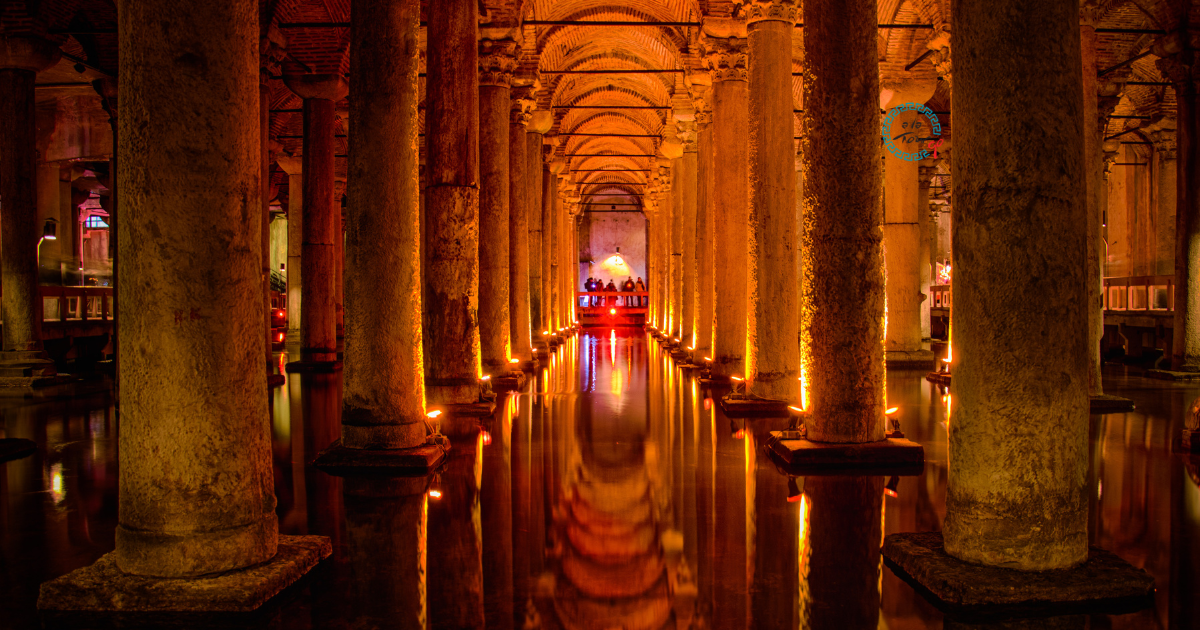
You walk down a staircase off a busy street in Sultanahmet and the temperature drops, the noise stops, and you are standing in a forest of marble columns with water underneath them. It takes most people about ten seconds to stop talking.
The Basilica Cistern is a reservoir, not a monument. It was built to do a job, and the fact that it is beautiful was never the point.
What it was for
Constantinople had a problem: it was a huge city on a peninsula with no river. Water came in by aqueduct from forests many kilometres away, and in a siege that supply could be cut. So the city stored it underground, in dozens of cisterns.
This is the largest of them, built under Justinian I in the sixth century, around the same decade as Hagia Sophia a few hundred metres away. It held roughly 80,000 cubic metres of water, enough to supply the Great Palace, and later the Ottoman palace above it, through a long siege.
The Ottomans half-forgot it. The story goes that it was rediscovered in the sixteenth century when a European scholar noticed that residents of the neighbourhood were pulling buckets of water, and occasionally fish, up through holes in their basement floors.
The columns, and where they came from
There are 336 columns, in twelve rows of twenty-eight, holding up the brick vaults. Look at them for a minute and you notice something odd: they do not match. Different marbles, different heights, different capitals, some Corinthian, some plain.
That is because almost none of them were made for this building. They were taken from older temples and ruins across the empire and reused. For a structure nobody was ever meant to see, spending money on matching columns would have been absurd.
The two Medusa heads
In the far northwest corner, two column bases are carved Medusa heads. One lies on its side. The other is completely upside down.
Nobody knows why, and the honest answer is more interesting than the theories. The usual explanations are that the heads were positioned to neutralise Medusa's power, or that they were simply the right size and shape to pack under a column and nobody cared which way up they went. The second is almost certainly true and the first is what everyone wants to hear.
They are also the most crowded three square metres in the building, so go there first or last.
What else to look for
- The Hen's Eye column, carved with teardrop and peacock-eye motifs. It is said to honour the slaves who died building the cistern; it is more likely reused from an older structure.
- The fish. There are carp in the water, and they are not decorative additions. The cistern has had fish for centuries.
- The sound. Stand still for a moment. Dripping water, very long reverb, and a deliberate low soundtrack added after the restoration.
Practical details
| Where | Sultanahmet, directly across from Hagia Sophia, on Alemdar Caddesi |
|---|---|
| Time needed | 30 to 45 minutes. It is smaller than people expect. |
| Tickets | Ticketed at the door and online, with separate day and evening sessions. The Museum Pass Türkiye does not cover it: it is run by the municipality, not the ministry. |
| Queue | Worst between 10:00 and 14:00. First entry or the last hour is far calmer. |
| Access | Stairs down and back up, with wet, uneven walkways in places. Not suitable for everyone. |
The restoration that closed it for five years and reopened it in 2022 raised the walkways, rebuilt the lighting and added contemporary art installations among the columns. Opinion is divided on the installations. The lighting, which is now coloured and slowly shifting, divides opinion more. Go knowing it is a staged space rather than a raw ruin, and it will not bother you.
Fitting it into a day
It is three minutes' walk from Hagia Sophia and five from the Blue Mosque, so it slots into a Sultanahmet morning without any planning. Because the visit is short and entirely indoors, it is also the obvious thing to do when it rains.
Our Istanbul Grand Tour covers the old city with a licensed guide, which matters here more than the labels suggest: without context this is a well-lit basement, and with it, it is the municipal engineering of an empire that expected to be besieged.
Türkiye'yi Keşfetmeye Hazır mısınız?
Uzman rehberlerimizle Türkiye'nin en etkileyici destinasyonlarında unutulmaz bir yolculuğa çıkın.
Turları Keşfet