EN
EN
 TR
TR
 DE
DE

Cappadocia Travel Guide: Fairy Chimneys, Cave Hotels & Hot Air Balloons
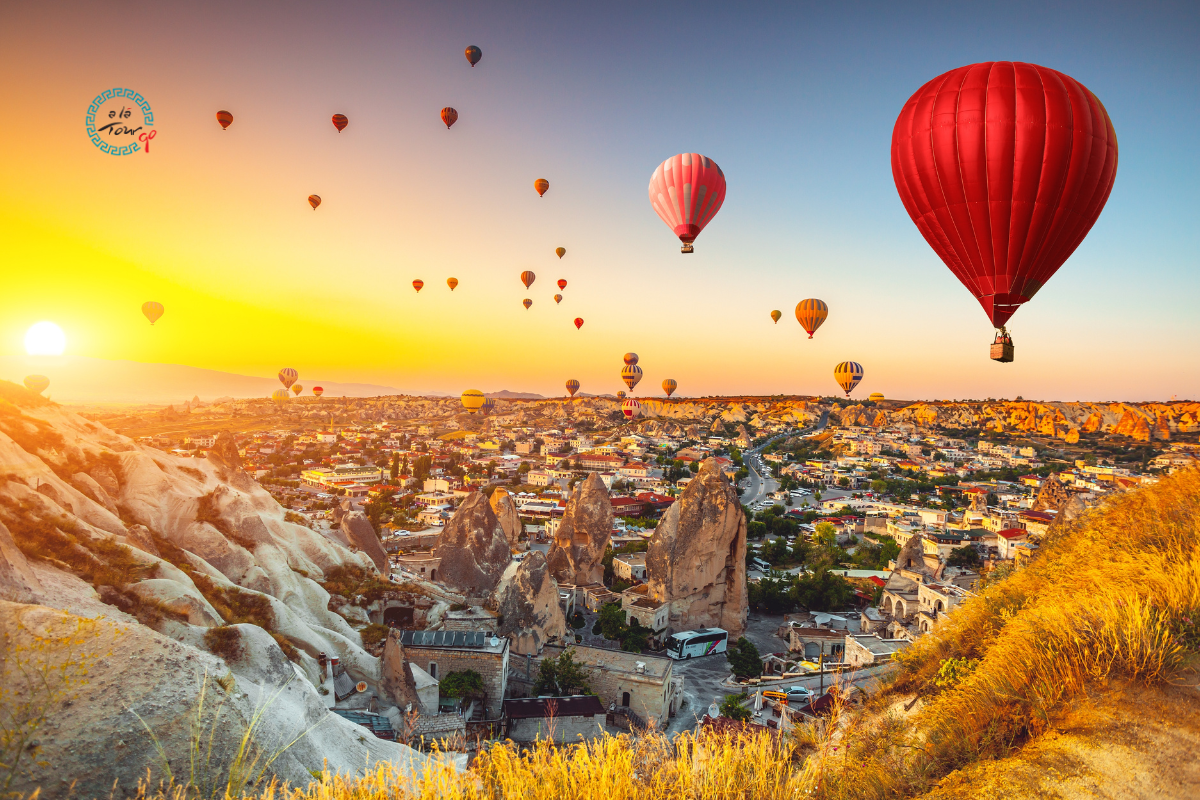
No photograph quite prepares you for Cappadocia. The landscape — a vast volcanic plateau in central Türkiye, eroded over millions of years into towers, cones, mushroom shapes and deep valleys — looks designed rather than natural. The soft volcanic tuff that makes up the rock was ideal for carving, and from the earliest Christian centuries through the medieval Byzantine period, the inhabitants of this region carved it into houses, churches, monasteries, stables and entire underground cities. The result is a landscape that is simultaneously geological wonder, open-air museum and living heritage site. It is, without question, one of the most extraordinary places on Earth.
How Cappadocia Was Formed
Between 9 and 3 million years ago, a series of volcanic eruptions from the nearby peaks of Erciyes, Hasandağ and Güllüdağ covered the central Anatolian plateau in deep layers of volcanic ash and lava. This material hardened into a soft rock called tuff, which is relatively easy to erode — and relatively easy to carve. Millions of years of wind and rain sculpted the tuff into the formations visible today: the tall conical "fairy chimneys," the broad valleys, the deep gorges and the undulating moonscape that extends in every direction from the main town of Göreme.
The fairy chimneys form where a harder cap of basalt sits atop a softer tuff column, protecting it from erosion while the surrounding rock erodes away. When the cap eventually falls — which it always does — the chimney begins to erode from the top and eventually disappears. The landscape is still changing.
Göreme Open-Air Museum
The Göreme Open-Air Museum is a UNESCO World Heritage Site and the most concentrated collection of Byzantine cave churches anywhere in the world. Within a relatively small area, over thirty rock-cut churches, chapels and monasteries dating from the 10th to 13th centuries contain frescoes of extraordinary quality — narrative scenes from the New Testament, portraits of saints, and decorative programmes that represent the peak of middle Byzantine painting outside Constantinople.
The Dark Church (Karanlık Kilise) is the most celebrated. Its frescoes — a complete New Testament cycle covering the Annunciation, the Nativity, the Baptism, the Transfiguration, the Entry into Jerusalem, the Crucifixion and the Resurrection — are among the best preserved in the region, protected for centuries by near-total darkness after the windows were blocked. The colours remain vivid: deep blues, warm reds and the characteristic Byzantine gold. The Dark Church requires a separate entrance ticket and is the single most important stop within the museum.
The Tokalı Church, just outside the main museum entrance, is the largest cave church in Cappadocia — its barrel-vaulted nave and transept covered floor to ceiling in a complete narrative fresco cycle that rivals the Dark Church in quality and surpasses it in scale.
Derinkuyu: The Underground City
Cappadocia's most surprising feature is invisible from the surface. Beneath the valleys and villages, the early Christian population carved an extensive network of underground cities into the tuff — places of refuge during periods of Arab raids between the 7th and 10th centuries AD. Derinkuyu is the largest and deepest accessible: eight floors descending 60 metres below the surface, with ventilation shafts, wells, stables, churches, wine presses, storage rooms and rolling stone doors that could be sealed from the inside.
The scale is difficult to comprehend until you are inside it — a city that could shelter 20,000 people, their animals and their food supplies for months at a time, completely invisible from above. Kaymakli, the other major accessible underground city, is connected to Derinkuyu by a tunnel 8 kilometres long (not open to visitors) and offers a different architectural arrangement at shallower depth.
The Hot Air Balloon
The hot air balloon flight over Cappadocia at sunrise is one of the most iconic travel experiences in the world — and one of the few that consistently lives up to its reputation. Conditions in the Göreme valley are unusually favourable for ballooning: the landscape is calm in the early morning, the valleys channel the thermals predictably, and the visual spectacle — dozens of balloons drifting above the fairy chimneys as the sun rises over Erciyes — is simply extraordinary.
Flights typically last 45 to 75 minutes and depart before dawn to catch the sunrise. Book well in advance, particularly in spring and autumn when the weather is most reliable and demand is highest. Flights are weather-dependent and can be cancelled at short notice — build flexibility into your schedule if the balloon is a priority.
The Valleys
Much of what makes Cappadocia remarkable is best experienced on foot, away from the main sites. Pigeon Valley (Güvercinlik Vadisi), named for the thousands of dovecotes carved into its cliff faces to collect pigeon droppings as fertiliser, connects Göreme to Uçhisar. Rose Valley (Güllüdere) and Red Valley (Kızılçukur) are renowned for the colour their tuff takes at sunset — deep reds, oranges and purples that change minute by minute as the light fades. Ihlara Valley, further south near Aksaray, is a 14-kilometre gorge carved by a river, its walls lined with Byzantine cave churches and its base a pleasant walking route through poplar trees beside the water.
Uçhisar, Ürgüp & Mustafa Paşa
Uçhisar Castle is the highest point in Cappadocia — a natural tuff formation riddled with carved rooms and tunnels, used as a fortress and watchtower for centuries. The view from the top extends across the entire region: Göreme below, Erciyes on the horizon, the valleys spreading in every direction. Ürgüp is the most established base town, with good hotel and restaurant infrastructure and a more local character than the busier Göreme. Mustafa Paşa, a former Greek Orthodox village emptied in the 1923 population exchange, has been slowly restored and offers a quieter, more atmospheric alternative.
Cave Hotels
Staying in a cave hotel is part of the Cappadocia experience. The best properties are carved into the tuff of the valley walls — their rooms maintaining a constant cool temperature in summer and warmth in winter regardless of the weather outside. The standard ranges from budget guesthouses to exceptional boutique properties with carved arches, antique furnishings and terraces with direct views over the fairy chimneys. Book early for the better properties, particularly in April, May, September and October.
Best Time to Visit
Spring (April–May) and autumn (September–October) are the best months — mild temperatures, reliable balloon conditions, good light for photography and manageable crowds. Summer is hot and busy but fully operational. Winter brings snow, which transforms the landscape into something genuinely magical — white fairy chimneys against a grey sky — and prices drop significantly, though balloon flights are less reliable.
Practical Information
The nearest airports are Kayseri (45 minutes by road) and Nevşehir (30 minutes). Both have connections to Istanbul. The main base towns are Göreme — the most central and tourist-oriented — and Ürgüp, which is larger and less concentrated. A rental car is useful for reaching the more distant valleys and sites, though most of the key attractions are accessible by local minibus or organised tour.
Cappadocia is the centrepiece of our Cappadocia, Konya & Ankara Heritage Tour — four days in the region including the Open-Air Museum, Derinkuyu, the valleys and the broader landscape, combined with Kayseri, Konya and Ankara.
Ready to see the fairy chimneys for yourself? See our Cappadocia tour with expert guides →
Türkiye'yi Keşfetmeye Hazır mısınız?
Uzman rehberlerimizle Türkiye'nin en etkileyici destinasyonlarında unutulmaz bir yolculuğa çıkın.
Turları Keşfet