EN
EN
 TR
TR
 DE
DE

Sümela Monastery: The Complete Guide to Türkiye's Cliff-Face Marvel
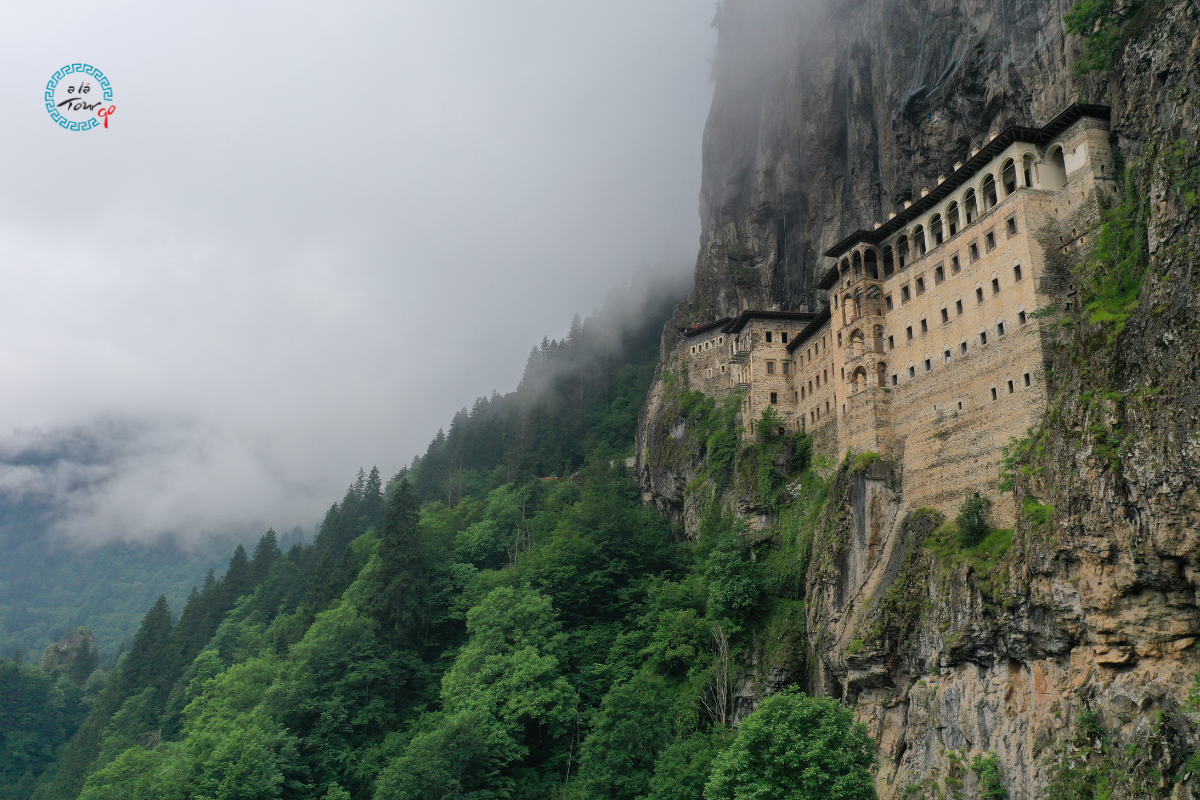
There are buildings that impress through scale, or through age, or through beauty. Sümela Monastery impresses through all three simultaneously — and adds a fourth quality that few buildings anywhere can claim: an impossible location. The monastery is built directly into a vertical cliff face in the Altındere Valley of the Pontic Mountains, 1,200 metres above sea level, the rock face rising above it and the valley dropping sharply below. It has been there, in various forms, since approximately 386 AD. Seeing it for the first time — emerging around a bend in the valley road with the monastery suddenly visible against the cliff — is a genuinely arresting experience.
History
According to tradition, Sümela was founded in the 4th century AD by two Athenian monks, Barnabas and Sophronios, who followed a miraculous icon of the Virgin Mary — believed to have been painted by Saint Luke — to a cave in the cliff face above the Altındere Valley. The icon, known as the Panagia Soumela, became one of the most venerated in the Orthodox world, and the monastery built around its cave became a major pilgrimage site for the Byzantine Empire and later for the Pontic Greek community of the eastern Black Sea coast.
The monastery was expanded, damaged, rebuilt and expanded again over the following centuries. The Pontic Greek kings of the Empire of Trebizond — who ruled this corner of the Black Sea coast as a Byzantine successor state from 1204 to 1461 — were among its most significant patrons, and many of the frescoes visible today date from their period. Under Ottoman rule, the monastery continued to function and received imperial firmans granting it protection and privileges from multiple sultans.
In 1923, during the population exchange that followed the Turkish War of Independence, the Greek Orthodox community of Trabzon was relocated to Greece, and the monks of Sümela were forced to abandon the monastery. Before leaving, they buried the Panagia Soumela icon in a secret location within the building. It was recovered in 1931 and eventually transferred to a monastery near Veria in northern Greece, where it remains today. A replica now hangs in the cave chapel at Sümela.
The monastery was opened to visitors as a museum in 1961. A major restoration project begun in 2015 partially closed sections of the site; as of the most recent information available, significant portions have reopened, though the extent of access may vary — the national park surrounding the site is always open.
What You Will See
The monastery complex consists of several interconnected structures built at different periods and at different levels of the cliff face. The approach is on foot — a well-maintained path through the Altındere forest climbs approximately 300 metres from the valley floor to the monastery entrance, taking around 30 to 45 minutes at a comfortable pace. The forest is dense and the sound of the river below accompanies most of the walk.
The main church, carved into the cliff and extended outward with constructed walls, contains the most important frescoes — a complete theological programme covering the interior walls and ceiling with scenes from the New Testament, portraits of the Pontic Greek royal family, and decorative borders of considerable sophistication. The colours have faded in places and been damaged by both time and deliberate defacement, but large sections remain legible and moving. The cave itself — the original sacred space — is at the back of the church, its walls blackened by centuries of candle smoke.
The cliff face frescoes on the exterior rock wall above the main church are among the most unusual features of the site — large-scale religious paintings applied directly to the natural rock, visible from across the valley. Their survival after sixteen centuries of Pontic weather is remarkable.
The guest rooms, kitchens, library and cisterns of the monastic complex are built outward from the cliff on multiple levels, their wooden balconies and stone walls creating the layered facade visible in every photograph of the site. The view from the upper levels — down the valley, over the forest canopy — gives a clear sense of why the founding monks chose this location: it is both defensible and, on clear days, extraordinarily beautiful.
The Altındere Valley
The national park surrounding Sümela is worth time beyond the monastery visit. The Altındere stream runs cold and fast through the valley floor, and the forest — mixed oak, beech, hornbeam and conifer — is among the most biodiverse in Türkiye. Brown bears are present in the upper reaches of the valley, though rarely seen. The drive through the valley on the approach to the monastery is itself scenic, and several cafes and trout restaurants at the valley entrance provide a natural stopping point before or after the climb.
The Annual Mass
Since 2010, an annual Orthodox Christian mass has been held at Sümela on the Feast of the Dormition of the Virgin (15 August), attended by Orthodox Christians from Greece, Russia, Georgia and the wider diaspora. The event has become one of the most significant moments in the Turkish-Greek cultural calendar and draws considerable media attention. If your visit coincides with this date, the atmosphere at the monastery is unlike any other day of the year.
Practical Information
Sümela is located approximately 45 kilometres south of Trabzon, in the Maçka district of Trabzon province. From Trabzon city centre, the drive takes approximately 50 minutes. Minibus services run from Trabzon to the valley entrance in summer; outside the peak season a taxi or rental car is more practical.
From the valley car park, the walk to the monastery takes 30 to 45 minutes uphill. The path is well maintained but steep in places — comfortable walking shoes are essential. The altitude means temperatures are noticeably cooler than on the coast even in summer; a light layer is advisable. The site is at its most atmospheric in misty conditions, which are common in the Pontic Mountains — the monastery emerging from low cloud above the forest is an image that stays with you.
Sümela is the centrepiece of our Uzungöl, Sümela & Black Sea Highlands Tour — a full day in the Altındere Valley combined with seven more days exploring the eastern Black Sea coast from Samsun to the Georgian border.
Ready to visit the cliff monastery? See our Black Sea Highlands tour with expert guides →
Ready to Experience Türkiye?
Let our expert guides take you on an unforgettable journey across Türkiye's most stunning destinations.
Explore Our Tours