EN
EN
 TR
TR
 DE
DE

Ephesus Travel Guide: Everything You Need to Know Before You Visit
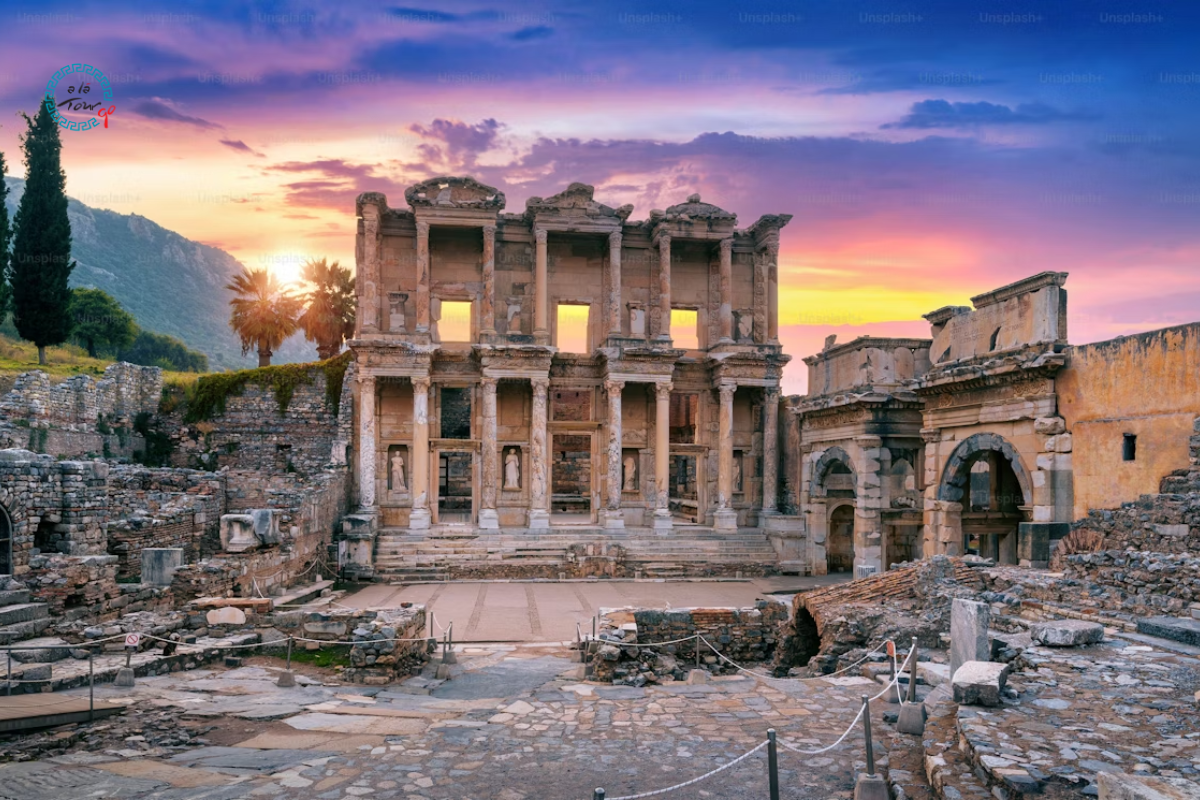
Ephesus was one of the greatest cities of the ancient world. At its peak under Roman rule, it was home to 250,000 people — the second largest city in the Roman Empire after Rome itself, the capital of the province of Asia Minor, and a centre of trade, philosophy, medicine and religious life that drew visitors from across the known world. Today it is the best-preserved Roman city in the eastern Mediterranean, and a visit here remains one of the most extraordinary experiences available to any traveller in Türkiye.
A Brief History of Ephesus
Ephesus was founded as a Greek colony around 1000 BC on a harbour at the mouth of the Cayster River. It grew rapidly into a major Ionian city, and in the 6th century BC its citizens began construction of the Temple of Artemis — a building so vast and so ornate that it was listed among the Seven Wonders of the Ancient World. The temple was destroyed and rebuilt multiple times; the final version, completed around 250 BC, stood for six centuries before being dismantled for building materials in the Byzantine period. A single reconstructed column marks the site today.
Under Roman rule, beginning in 129 BC, Ephesus became the wealthiest and most important city in Asia Minor. The emperor Augustus made it the seat of the Roman governor, and the city expanded dramatically — the theatre, the agora, the baths, the brothel, the library and the colonnaded streets that visitors walk today all date largely from this period. Saint Paul preached here in the 1st century AD and wrote his Epistle to the Ephesians from prison in Rome. The Gospel of John may have been written here. The Virgin Mary is believed by many to have spent her final years in a house on the hill above the city.
By the Byzantine period, the harbour had silted up — the coastline is now 5 kilometres away — and the city began its long decline. It was abandoned entirely in the 15th century and lay buried under silt and soil until systematic excavations began in the 1860s.
What to See at Ephesus
The main archaeological site is entered from either the upper or lower gate — most guided tours enter from the upper gate and walk downhill toward the harbour road, which is the most logical route. The key sites along the way include:
The Library of Celsus is the image most associated with Ephesus — a two-storey Roman facade built in 117 AD as a tomb and library for the Roman governor Celsus, its columns and niches restored to full height in the 1970s. It held approximately 12,000 scrolls, making it the third-largest library in the ancient world after Alexandria and Pergamon.
The Great Theatre could seat 25,000 spectators and is still used for concerts today. It was here, according to the Acts of the Apostles, that a silversmith named Demetrius incited a riot against Saint Paul for threatening the trade in silver shrines of Artemis.
The Terrace Houses are the most remarkable — and most often skipped — part of the site. Six Roman townhouses built on the hillside between the 1st and 7th centuries AD have been excavated and covered by a protective structure. Inside, the original mosaic floors, frescoed walls and marble decoration survive in extraordinary condition. The quality and completeness of the domestic interiors gives a physical sense of wealthy Roman life that no museum display can match. The Terrace Houses require a separate entrance ticket and are worth every cent.
The Marble Street connects the library to the theatre along a colonnaded road whose ruts, worn by Roman cart wheels, are still visible in the stone. The public latrine, the brothel, the Temple of Hadrian, the Fountain of Trajan and the Gate of Mazaeus and Mithridates all line the main routes through the city.
The Temple of Artemis
The Temple of Artemis site is located 2 kilometres from the main excavation, near the town of Selçuk. What was once one of the Seven Wonders of the Ancient World is now a single reconstructed column standing in a marshy field. The contrast between the scale of what once stood here — 127 columns, each 18 metres tall, in a building four times the size of the Parthenon — and what remains is striking in its own way. The Ephesus Museum in Selçuk houses the finds from the temple excavations, including a remarkable collection of statues of Artemis.
Şirince Village
Eleven kilometres above Ephesus, the village of Şirince sits on a hillside among olive and fruit orchards. It was settled by Greek Orthodox Christians who were displaced in the 1923 population exchange, and their stone houses — restored and converted into boutique hotels and wine shops — give the village a character unlike anywhere else on the Aegean. The local fruit wines are famous. An hour here after the main site makes for a perfect afternoon.
Practical Information
Ephesus is located near the town of Selçuk in İzmir province, approximately 80 kilometres south of İzmir city centre. The nearest airport is Adnan Menderes in İzmir, with direct flights from most major European cities. From İzmir, Ephesus is accessible by train to Selçuk (approximately 1 hour) or by road (approximately 1 hour 15 minutes).
The site is open daily. The best time to visit is early morning — the main streets become crowded by mid-morning, particularly in summer, and the marble surfaces reflect considerable heat. Comfortable walking shoes are essential; the site covers several kilometres of uneven stone surfaces. The Terrace Houses ticket is sold separately at the site entrance and is strongly recommended.
A guided visit makes a significant difference at Ephesus. The density of monuments and the layers of historical and literary association — Roman, early Christian, Byzantine — require explanation to be fully appreciated. Walking through without context means missing most of what makes the site extraordinary.
The most complete way to experience Ephesus is as part of a broader Aegean tour that also takes in Şirince, the Temple of Artemis, Kuşadası and the surrounding coast. Our Ephesus, Bodrum & Turquoise Coast Tour includes a full guided day at the site alongside seven more days of the western Aegean.
Ready to walk the marble streets? See our Ephesus tour with expert guides →
Ready to Experience Türkiye?
Let our expert guides take you on an unforgettable journey across Türkiye's most stunning destinations.
Explore Our Tours