EN
EN
 TR
TR
 DE
DE

Pergamon Travel Guide 2026: Turkey's Forgotten Hellenistic City
Ephesus gets the visitors. Pergamon gets the silence. Both are extraordinary ancient cities of comparable historical significance, both are in the İzmir region of western Turkey, and both are UNESCO World Heritage Sites. But Ephesus sees millions of visitors each year while Pergamon receives a fraction of that number. Walk through Pergamon's acropolis on a weekday morning in May and you may be the only person at the site. This is either a problem or an opportunity, depending entirely on what you are looking for.
What Was Pergamon?
Pergamon (modern Bergama) reached its peak as the capital of the Kingdom of Pergamon between the 3rd and 1st centuries BC — one of the successor states of Alexander the Great's empire. At its height it was home to approximately 200,000 people and was among the most culturally significant cities in the Hellenistic world.
Three things made Pergamon exceptional:
The Library of Pergamon — the second greatest library of the ancient world after Alexandria. When Egypt cut off papyrus exports to prevent Pergamon from overtaking Alexandria's collection, Pergamon invented parchment (pergament in German and Turkish — the word itself comes from the city's name). The library eventually housed 200,000 scrolls; when Mark Antony gave it to Cleopatra, the entire collection was moved to Alexandria.
The Asklepion — the most famous medical sanctuary in the ancient world. Patients came from across the Mediterranean to be treated by the physician-priests of Asclepius, god of medicine. The treatments included dream analysis, mud baths, herbal remedies and the earliest recorded use of running water in a medical context. Galen — the most influential physician between Hippocrates and Harvey — was born in Pergamon.
The Theatre — built into the hillside of the acropolis at an 80-degree gradient, it is the steepest ancient theatre in the world. Sitting in its upper tiers, looking down at the stage and then across the plain of the Caicus River, is one of the most vertiginous experiences in ancient architecture.
What to See in Pergamon
The Acropolis (Allow 2.5–3 hours)
The acropolis of Pergamon sits on a dramatic rocky outcrop approximately 400 metres above the modern city of Bergama. It is reached either by a winding road (taxi or car) or by cable car (teleferik) from the lower city.
What you see on the acropolis:
The Theatre — 80-degree gradient, capacity approximately 10,000. The retaining wall below the theatre is exceptional Roman engineering. The view from the upper tiers — over the ruins, the plain below and the mountains — is extraordinary.
The Altar of Zeus Platform — the Altar of Zeus (2nd century BC) was considered one of the Seven Wonders of the Ancient World by some ancient writers. The altar itself was excavated by German archaeologists in the 19th century and transported to Berlin, where it remains in the Pergamon Museum. The platform it stood on remains — a wide marble terrace with the foundations still visible. The frieze from the altar (the Gigantomachy — gods fighting giants) is considered one of the greatest works of Hellenistic sculpture.
The Library Site — the rooms of the ancient library are visible adjacent to the Temple of Athena. The standard museum interpretation labels these as the library; some recent scholarship questions this identification, but the site is still atmospheric.
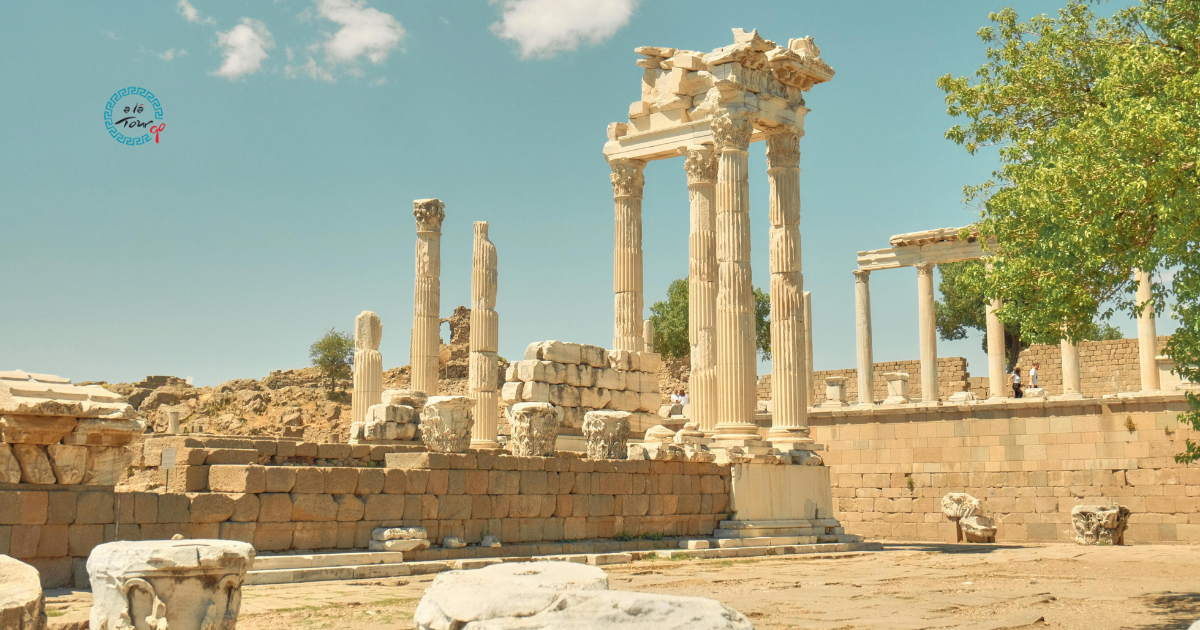
The Temple of Trajan — the best-preserved structure on the acropolis, built in the 2nd century AD to honour the emperor Trajan. The marble columns and portions of the entablature have been partially re-erected, giving a strong sense of the building's original scale.
Pergamon is on our Aegean Region tour route →
The Asklepion (Allow 1.5 hours)
The Asklepion is located at the base of the hill, approximately 3km from the acropolis. It was the most famous medical sanctuary in the ancient Mediterranean — combining the functions of a temple, a hospital and a spa.
What you see:
- The sacred way (colonnaded processional road leading to the complex)
- The treatment pools — patients would sleep beside or in these pools, and their dreams would be interpreted as diagnostic
- The theatre within the complex — patients also took part in theatrical performances as part of treatment
- The tunnel system — an underground passage where patients would undergo treatments involving sound and running water
- The Temple of Asclepius — a smaller version of the Pantheon in Rome, built in the 2nd century AD
The Asklepion is significantly less visited than the acropolis and often entirely empty in the afternoon. Allow time here — the atmosphere is extraordinary.
The Red Basilica (Kızıl Avlu)
In the lower city of Bergama, directly on the banks of the Selinus River, stands one of the most unusual monuments in Turkey. The Red Basilica (Kızıl Avlu) was built in the 2nd century AD as a temple to the Egyptian gods Serapis and Isis — one of the largest and most unusual Roman religious structures in Anatolia. Its massive red-brick walls (the largest remaining Roman brick structure in Turkey) stand almost to their full original height.
Unusual fact: The building was constructed over the Selinus River — the river still flows through tunnels beneath the building's foundation, a Roman engineering feat visible from the structure's courtyard.
Allow: 45 minutes.
Bergama Archaeological Museum
The museum in the lower town covers the finds from Pergamon that were not taken to Berlin — including smaller sculptures, coins, everyday objects and inscriptions that give a more human-scale picture of life in the ancient city.
Allow: 1 hour.
Practical Information
Getting to Bergama:
- From İzmir: 100km north, approximately 1.5 hours by road. Frequent buses from İzmir Otogar (bus terminal). By rental car, the drive is straightforward.
- From Istanbul: Direct buses from Istanbul's main terminals; approximately 6–7 hours. Not recommended as the primary destination — better combined with İzmir.
Cable car (Teleferik): The cable car connecting lower Bergama to the acropolis runs approximately 08:30–17:30 daily. A return ticket is approximately €5. Walking up is possible but takes 45–60 minutes on a steep path.
Best time to visit:
- April–June: Best weather, wildflowers on the acropolis hillside, comfortable temperatures
- September–October: Excellent conditions, harvest atmosphere in the surrounding olive groves
- Avoid July–August midday — the acropolis is exposed and very hot
How long to spend: Acropolis + Asklepion + Red Basilica = full day. Add the museum and it is 1.5 days. Bergama has good small hotels if you prefer not to day-trip from İzmir.
Why Choose AlaTourqo?
As TÜRSAB #16222-certified operators, our Aegean tours include Pergamon alongside Ephesus, Pamukkale and the Turquoise Coast — with expert local guides who bring the Hellenistic history to life.
Reach us via the WhatsApp button on the right side of our website — we respond within 24 hours.
Ready to Experience Türkiye?
Let our expert guides take you on an unforgettable journey across Türkiye's most stunning destinations.
Explore Our Tours