EN
 TR
 DE

Halfeti: Turkey's Sunken Village on the Euphrates — Complete Visitor Guide 2026
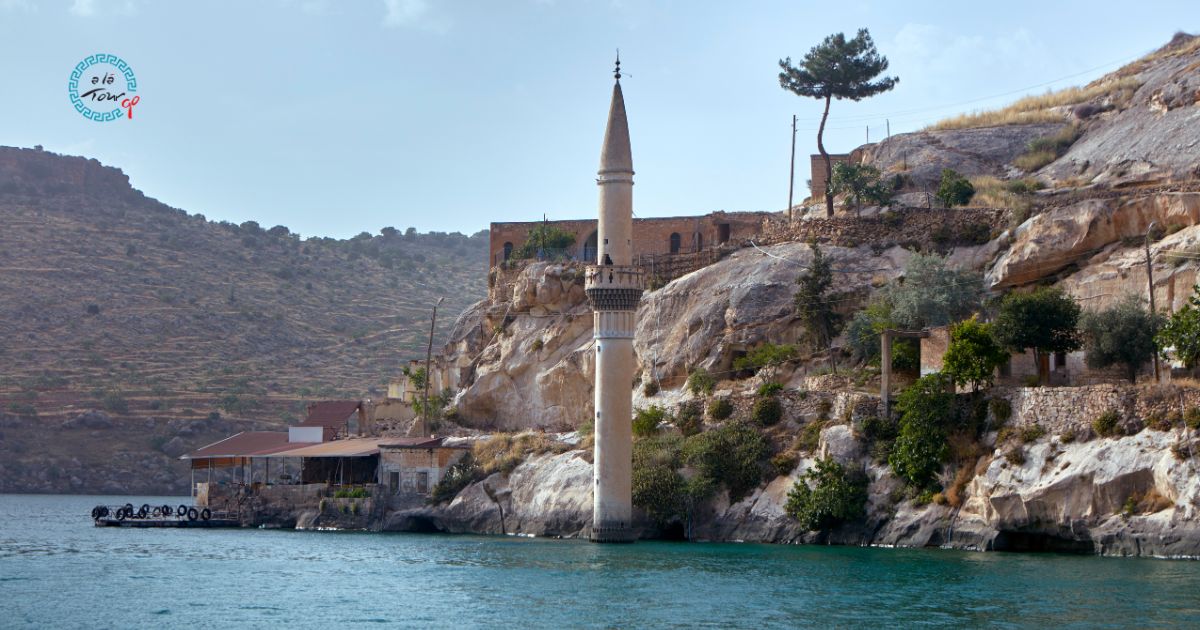
Halfeti is the kind of place that stops people mid-scroll. A minaret rising directly from the water. A village that was partially submerged when a dam was built in 2000. Boat tours that pass over where streets and houses used to be. Black roses — a colour produced nowhere else on earth — growing along the banks. And the ruins of Rumkale castle, accessible only by boat, rising from a rocky promontory entirely surrounded by water.
It is one of the most visually unusual places in Turkey and one of the most emotionally resonant. Here is everything you need to know to visit it.
What Happened to Halfeti?
The story of Halfeti begins with the Birecik Dam, completed in 2000 as part of Turkey's Southeastern Anatolia Project (GAP) — a massive infrastructure development programme that built hydroelectric dams along the Euphrates and Tigris rivers.
When the dam was completed, the Euphrates rose significantly in this section. The villages of Eski (Old) Halfeti and Savaşan were among those that were partially or fully submerged. Residents were relocated to Yeni (New) Halfeti — a new settlement built on higher ground nearby.
The old village did not disappear entirely. The upper portions of some buildings remain above the waterline. The minaret of the old mosque at Savaşan rises directly from the water — one of the most photographed images in Turkey and one of the strangest. Depending on the season and the reservoir water level, more or less of the old settlement is visible.
The result is a landscape unlike anything else in Turkey — a drowned village, a flooded canyon, a submerged culture still partially visible above the waterline.
The Boat Tour — The Main Experience
The primary way to experience Halfeti is by boat. Wooden boats depart from the small harbour in Yeni Halfeti throughout the day, taking visitors upstream along the flooded section of the Euphrates.
What you see on the boat tour:
- The submerged minaret of the old Savaşan mosque — rising from the water, with the flooded village visible around and below it
- The Euphrates canyon walls — sheer limestone cliffs rising from the water, with the ruins of ancient settlements visible on the upper terraces
- Rumkale castle — the ancient fortress perched on a rocky promontory, now entirely surrounded by water since the dam raised the river level
- The drowned orchards and fields — visible as greenish shapes under the water on clear days in the right light
- Submerged structures — walls and foundations of buildings visible below the surface in shallow sections
Duration: Most standard boat tours last approximately 1.5 to 2 hours. Extended tours that include a stop at Rumkale castle take approximately 3 hours.
Timing tip: The boat tour is most atmospheric in late afternoon, when the canyon walls are lit from the west and the water turns golden. If staying overnight in Halfeti, take the late afternoon boat and the morning boat on consecutive days — the light is different and equally extraordinary at both times.
Rumkale — The Floating Fortress
Rumkale — literally "the Castle of the Romans" — is one of the most dramatically sited fortresses in southeastern Turkey. Built on a rocky promontory above the Euphrates, it has been used variously by the Byzantines, the Crusaders, the Armenians and the Seljuks over a period of more than a thousand years.
Since the dam raised the water level, Rumkale now appears to rise directly from the river — the surrounding land is submerged and the castle promontory is accessible only by boat.
What to see at Rumkale:
- Byzantine-era church foundations
- Crusader-period towers and walls
- Carved cisterns cut into the rock
- The view from the top — over the Euphrates canyon, the flooded valley and the surrounding limestone plateau — is exceptional
Practical note: Most boat tours include a stop at Rumkale with time to explore the castle ruins on foot. Confirm this with your boat operator before departure.
The Black Rose of Halfeti
Halfeti is famous throughout Turkey for a botanical phenomenon: the siyah gül, the black rose.
Roses of an extraordinarily deep, near-black red — a colour produced by the specific combination of the Euphrates River water chemistry and the mineral composition of the local soil — grow in and around Halfeti and almost nowhere else in the world. The colour is not truly black — in direct sunlight it appears deep crimson, shifting toward true black in shade or as the flower ages.
When to see them:
- First bloom: Late April to May
- Second bloom: October
If you are visiting outside these windows, the roses will not be flowering — but the village and boat tour are worth visiting regardless.
The black rose has become the symbol of Halfeti and of the melancholy associated with the drowned village. It appears on local products, cafés and souvenirs throughout the new town.
Yeni Halfeti — The New Town
The new town of Halfeti, built on higher ground above the reservoir, is small — a few streets of houses, some cafés and restaurants along the waterfront, the boat harbour and a handful of guesthouses. It has developed a modest tourism infrastructure since the flooding made the old village into an attraction.
Where to eat: The waterfront restaurants serving grilled fish from the Euphrates are the best option. Order the local fish — caught from the reservoir — rather than imported meat dishes.
Where to stay: Several small guesthouses and boutique hotels have opened in recent years. Staying overnight allows you to experience the late afternoon and early morning light on the water, which is the most atmospheric time.
Practical Information
Location: Halfeti is approximately:
- 100 kilometres northwest of Şanlıurfa (approximately 1.5 hours by road)
- 120 kilometres from Gaziantep (approximately 1.5 to 2 hours)
- 350 kilometres from Adıyaman (for those combining with Nemrut)
Getting there:
- From Şanlıurfa or Gaziantep by car or taxi — no reliable public transport directly to Halfeti
- Most visitors come on a day trip from Şanlıurfa or as part of a guided tour of the region
Best combination: Halfeti + Şanlıurfa (2 days) or Halfeti + Şanlıurfa + Gaziantep (3 days)
Best time to visit:
- April–June: Black roses in first bloom (May); comfortable temperatures; water levels stable
- September–October: Second rose bloom (October); autumn light excellent; fewer visitors
- Avoid July–August: Temperatures reach 40–42°C in this region; extremely hot for a boat tour
Want to visit Halfeti as part of a guided tour?
Our Southeastern Anatolia Tour includes Halfeti alongside Göbeklitepe, Şanlıurfa, Mardin and Nemrut — with expert local guides and all logistics handled.
Reach us via the WhatsApp button on the right side of our website — we respond within 24 hours.
Ready to Experience Türkiye?
Let our expert guides take you on an unforgettable journey across Türkiye's most stunning destinations.
Explore Our Tours