EN
EN
 TR
TR
 DE
DE

Pamukkale Travel Guide: The Cotton Castle of Türkiye
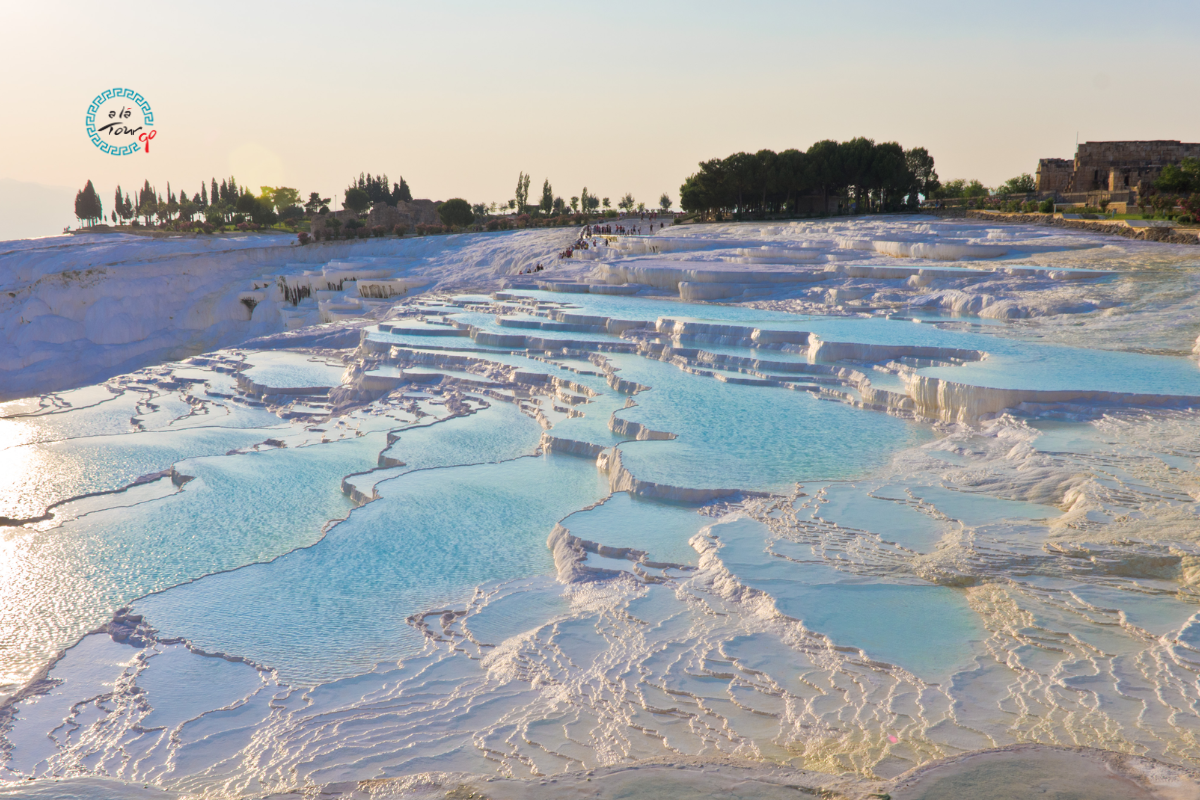
Pamukkale means "cotton castle" in Turkish, and the name is apt. From a distance, the hillside looks as though it has been draped in white fabric — a series of shallow terraced pools filled with warm mineral water, their rims built up over millennia by calcium carbonate deposits left by the thermal springs above. Up close, it is stranger and more beautiful than the photographs suggest. And directly above, the ruins of Hierapolis — a Roman spa city established in the 2nd century BC — spread across the plateau for over a kilometre. Together, Pamukkale and Hierapolis form one of Türkiye's two UNESCO World Heritage Sites on the same location, and one of the most visually extraordinary places in the Mediterranean world.
How Pamukkale Was Formed
The travertines are entirely natural. Thermal water emerges from the springs above the cliff at a constant 35°C, saturated with calcium bicarbonate. As it flows down the hillside and cools, the calcium carbonate precipitates out of solution and deposits on the surfaces below, building up the white terraced pools over thousands of years. The process is ongoing — the travertines are still growing, though slowly, and the colour and water level of the pools change with the seasons and the flow rate of the springs.
The white surfaces are soft and slightly slippery underfoot. Visitors are required to remove their shoes before walking on the travertines — a rule that protects both the surface and the visitor. The warm water in the pools is shallow, rarely more than ankle-deep except in the larger basins near the top.
Hierapolis: The Roman Spa City Above
Hierapolis was founded as a thermal spa city by the kings of Pergamon around 190 BC and passed to Rome in 133 BC. Under the emperors, it grew into a prosperous city of perhaps 100,000 people — drawn by the thermal springs whose waters were believed to have healing properties. The city was a centre of early Christianity: Philip the Apostle is believed to have been martyred here in 80 AD, and the Martyrium of Saint Philip, a large octagonal church, still stands on the hill above the city.
The Theatre is the most immediately impressive structure — a Roman theatre of the 2nd century AD, extensively restored, with its stage wall standing to near full height and decorated with relief carvings depicting scenes from the life of Apollo. It seats 15,000 and the view from the upper rows extends across the travertines and the Lycus Valley below.
The Necropolis stretches for over a kilometre along the northern road out of the city and is the largest ancient burial ground in Asia Minor — thousands of sarcophagi, tumuli and tomb monuments of every type and period, from the Hellenistic through the Byzantine era. Walking through it in the early morning, before the day-trippers arrive, is a genuinely affecting experience.
The Antique Pool — universally known as Cleopatra's Pool, though Cleopatra almost certainly never visited — is the thermal swimming pool fed directly by the springs. The water temperature is 36°C year-round. An earthquake at some point in antiquity toppled a Roman colonnade into the pool, and the original marble columns, capitals and architectural fragments now lie on the bottom, visible through the clear water. Swimming among submerged Roman ruins in thermal water is an experience available nowhere else on Earth. The pool requires a separate entrance fee and is worth it.
The Hierapolis Archaeology Museum, housed in the restored Roman baths building at the edge of the site, contains an excellent collection of sarcophagi, friezes and statuary from the excavations — particularly the collection of Aphrodite sculptures from the nearby ancient city of Aphrodisias.
Aphrodisias: The City Worth the Detour
Approximately 100 kilometres from Pamukkale, Aphrodisias is one of the finest and least-visited Roman archaeological sites in Türkiye. Built around the sanctuary of Aphrodite — the goddess of love — it reached its peak in the 1st and 2nd centuries AD as a centre of sculpture: the white marble quarried from the nearby mountains was used for statues exported across the Roman Empire. The stadium, one of the best-preserved in the ancient world, held 30,000 spectators. The tetrapylon gateway, the baths of Hadrian and the museum of sculpture are all outstanding. If you are already going to Pamukkale, Aphrodisias is a natural extension.
Best Time to Visit
Pamukkale is open year-round, but the experience differs significantly by season. In summer the pools can be crowded and the white surfaces reflect considerable heat — early morning visits (the site opens at 6am) are strongly recommended. In spring and autumn the crowds are thinner and the light is better for photography. In winter the site is quiet, the water still warm, and the white terraces occasionally dusted with frost — a genuinely beautiful combination.
The travertines are best photographed in the late afternoon when the low light catches the water in the pools. The view from below, looking up at the white hillside, is the classic image — accessible from the town of Pamukkale directly below the site.
Practical Information
Pamukkale is located near Denizli in western Türkiye, approximately 250 kilometres east of İzmir and 200 kilometres north of Antalya. The nearest airport is Denizli Çardak, with connections to Istanbul. From Denizli, the site is approximately 20 kilometres by road. The town of Pamukkale at the base of the site has a good range of hotels, including several with their own thermal pools fed by the same springs.
The main site entrance is at the top of the travertines, near the Hierapolis ruins. A second entrance at the base allows access to the travertines from below. Shoes must be removed before walking on the travertine surface — bags are provided at the entrance for carrying them. The Antique Pool is within the site but requires a separate ticket purchased at its own entrance.
Pamukkale is most rewarding as part of a broader tour of western Türkiye that connects it with Ephesus, Aphrodisias and the Aegean coast. Our Pamukkale, Lakes & Ancient Cities tour includes a full day at the site alongside seven more days of western Anatolia's most remarkable places.
Ready to walk the white terraces? See our Pamukkale tour with expert guides →
Ready to Experience Türkiye?
Let our expert guides take you on an unforgettable journey across Türkiye's most stunning destinations.
Explore Our Tours