EN
EN
 TR
TR
 DE
DE

Lake Van, Ishak Pasha & Ani Ruins: The Complete 8-Day Eastern Anatolia Guide
Eastern Anatolia is Türkiye's final frontier for tourism — a vast, high-altitude landscape where the distances are enormous, the history is ancient and the rewards are proportional. Most visitors never make it this far east, which means those who do have the ruins, the lakes and the mountain roads largely to themselves. Over eight days, this tour moves from Diyarbakır through Batman, Bitlis, Van, Doğubeyazıt, Iğdır, Kars and Erzurum — a loop through the eastern edge of the country that connects Armenian, Kurdish, Ottoman, Russian and early Turkish Republican history in a single journey. Our Lake Van, Ishak Pasha & Ani Ruins Tour is for travellers who want the road less taken.
Day 1–2: Batman, Malabadi Bridge, Bitlis & the Ahlat Seljuk Graveyard
The tour begins in Diyarbakır and heads east through Batman — a city whose name belies a landscape of ancient rock formations and river valleys. The Malabadi Bridge, spanning the Batman River, was built in 1147 and remains one of the largest single-arch stone bridges from the medieval Islamic world. Its span of 38 metres was unmatched in its era.
Bitlis, a narrow city built along a mountain gorge, was one of the most important commercial centres on the Silk Road — a meeting point of Kurdish, Armenian and Ottoman cultures whose old bazaar and fortress still carry the weight of that history. The Ahlat Seljuk Graveyard, on the western shore of Lake Van, is one of the most remarkable and least visited sites in Türkiye: thousands of elaborately carved medieval tombstones spreading across a field above the lake, many dating to the 11th and 12th centuries, the carvings still sharp after nine hundred years.
Day 3: Lake Van — Akdamar Island & Van Castle
Lake Van is the largest lake in Türkiye and one of the largest soda lakes in the world — its water so alkaline it feels different to swim in, its colour an extraordinary shade of blue-green that shifts with the light and the season. The lake sits at 1,640 metres above sea level, surrounded by volcanic mountains, and on clear days the view across it is simply one of the most beautiful in the country.
Akdamar Island sits in the lake a kilometre offshore, accessible by boat. The Church of the Holy Cross, built in 921 AD by the Armenian King Gagik I, stands on the island's highest point — its exterior walls covered in carved stone reliefs depicting biblical scenes, still sharp after eleven centuries. The quality of the carving and the setting — a church on an island in a mountain lake — make this one of the most memorable visits on any tour of Türkiye.
Van Castle, back on the mainland, is a Urartian fortress built in the 9th century BC on a rock above the old city — with cuneiform inscriptions of Xerxes the Great still legible in the stone. The Van Cat House introduces the world-famous locally bred cats with their distinctive heterochromia — one blue eye, one amber.
Day 4: Muradiye Waterfall, Ishak Pasha Palace & Iğdır
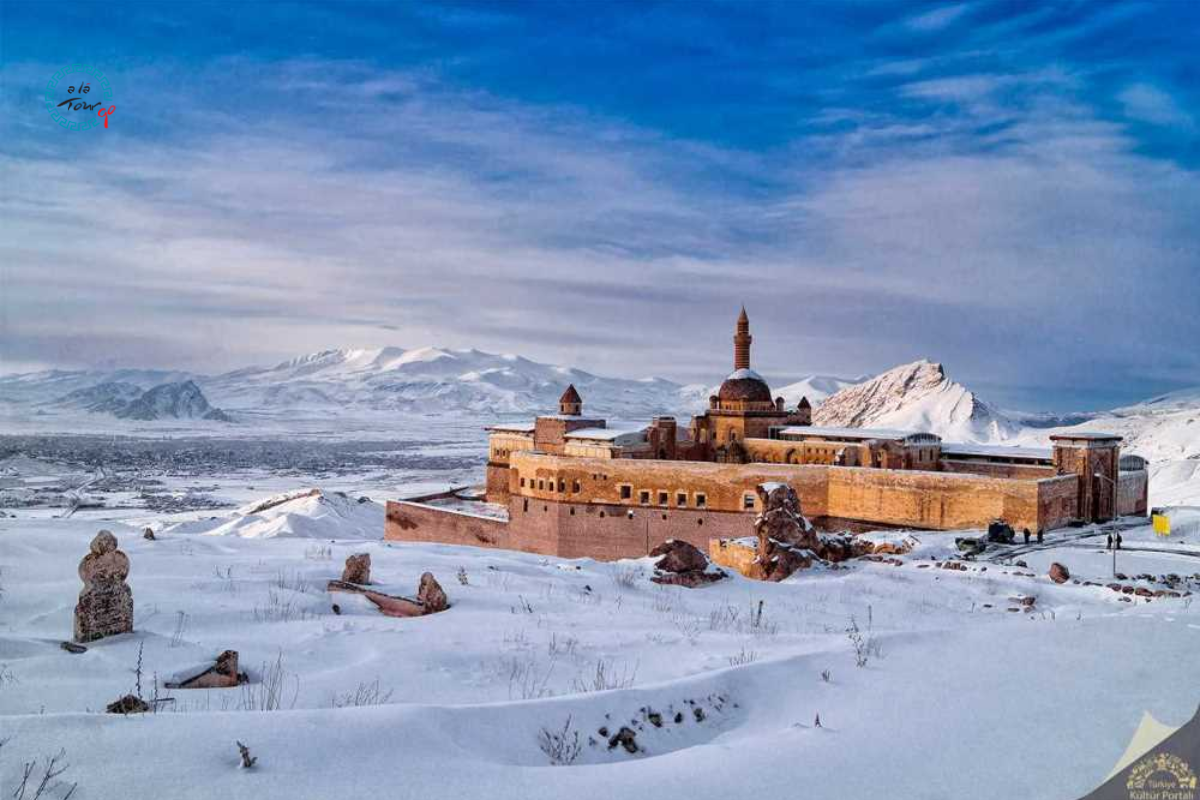
Muradiye Waterfall drops from a basalt cliff in multiple tiers — a dramatic natural stop before the drive east to Doğubeyazıt and the tour's centrepiece. Ishak Pasha Palace sits on a rocky promontory at 2,000 metres above sea level, looking down at the plain below with Mount Ararat visible on one side and the Iranian border on the other. Built between 1685 and 1784 by the Çıldıroğulları dynasty, it combines Ottoman, Persian, Armenian and Georgian architectural elements in a building that has no equivalent anywhere in Anatolia.
The palace has 366 rooms — one for each day of the year — and its carved stone portal is considered one of the finest examples of Ottoman decorative stonework in existence. The setting alone would justify the journey: a palace balanced on the edge of a cliff, with a ruined Urartian fortress above and an infinite mountain plain below.
The afternoon crosses into Iğdır province — a region that grows figs, pomegranates and cotton at the base of Ararat's shadow — before the night stop at Tuzluca, where natural salt caves have been carved into the landscape for centuries.
Day 5: Kars, Ani Ruins & the Russian Quarter
Ani was the capital of the medieval Armenian Bagratid kingdom and, at its peak in the 10th century, one of the largest cities in the world — home to perhaps 100,000 people, with churches, mosques, palaces and caravanserais crowded within its walls. Today it is a ghost city on the Armenian border, its ruins spread across a plateau above the Arpaçay River gorge. The Cathedral of Ani, built in 1001, still stands to almost full height. The Church of St. Gregory, the Convent of the Virgins, the Silk Road bridge and the city walls carry centuries of Armenian, Seljuk, Georgian and Mongol history in their stones.
Kars itself — the night's base — is one of Türkiye's most unusual cities, its grid-plan streets and stone apartment buildings a legacy of 40 years of Russian occupation between 1878 and 1918. The Russian residences, the Fethiye Mosque (originally a Russian Orthodox church), the Kanli Tabya fortress and the covered bazaar give the city a character found nowhere else in Türkiye. The evening ends with a Caucasian Night — live music and local food from the region's distinct culinary tradition.
Day 6: Sarıkamış, Erzurum & the Seljuk Monuments
The road to Erzurum passes Sarıkamış — site of one of the most catastrophic military defeats in Ottoman history, where 90,000 soldiers died in the winter of 1914–15 in a failed offensive against Russian forces. The monument there is spare and sobering. Çoban Dede Bridge, a 16th-century Ottoman structure spanning a mountain river, provides the contrast.
Erzurum was the most important city in eastern Anatolia for centuries and its medieval monuments reflect that status. The Çifte Minareli Madrasa — built in 1253, its twin minarets still intact — is the finest Seljuk building in the city. The Üç Kümbetler (Three Tombs), the Yakutiye Madrasa, the Erzurum Castle and the Erzurum Congress Building — where Atatürk organised the resistance movement in 1919 — cover thirteen centuries of history within walking distance of each other.
Day 7: Bingöl, Nene Hatun & the Return to Diyarbakır
The final full day crosses the Bingöl mountains — high, sparsely populated, dramatic — with a stop at the Nene Hatun Historical National Park, commemorating the 1877 Russian siege of Erzurum and the women who fought in its defence. The Aziziye Fortress, scene of some of the heaviest fighting, overlooks the city from above. The long drive back to Diyarbakır closes the loop.
What's Included
The tour covers 8 days and 7 nights with accommodation in quality hotels across Diyarbakır/Batman, Van, Kars and Erzurum (Hilton, Mövenpick, Ramada and equivalents). Included: private vehicle throughout, 7 breakfasts, 7 lunches or dinners, boat transfer to Akdamar Island, Caucasian Night dinner with entertainment, all museum and site entrance fees, professional guides, mandatory travel insurance and tour souvenirs. Not included: international flights and personal expenses.
Dates & Pricing
Three departures are available: 18 April 2026 (12 spots), 5 September 2026 (16 spots) and 24 October 2026 (28 spots). Pricing starts from €1,199 per person in a double or twin room.
Ready to explore the real east? View full tour details and book your place →
Ready to Experience Türkiye?
Let our expert guides take you on an unforgettable journey across Türkiye's most stunning destinations.
Explore Our Tours